
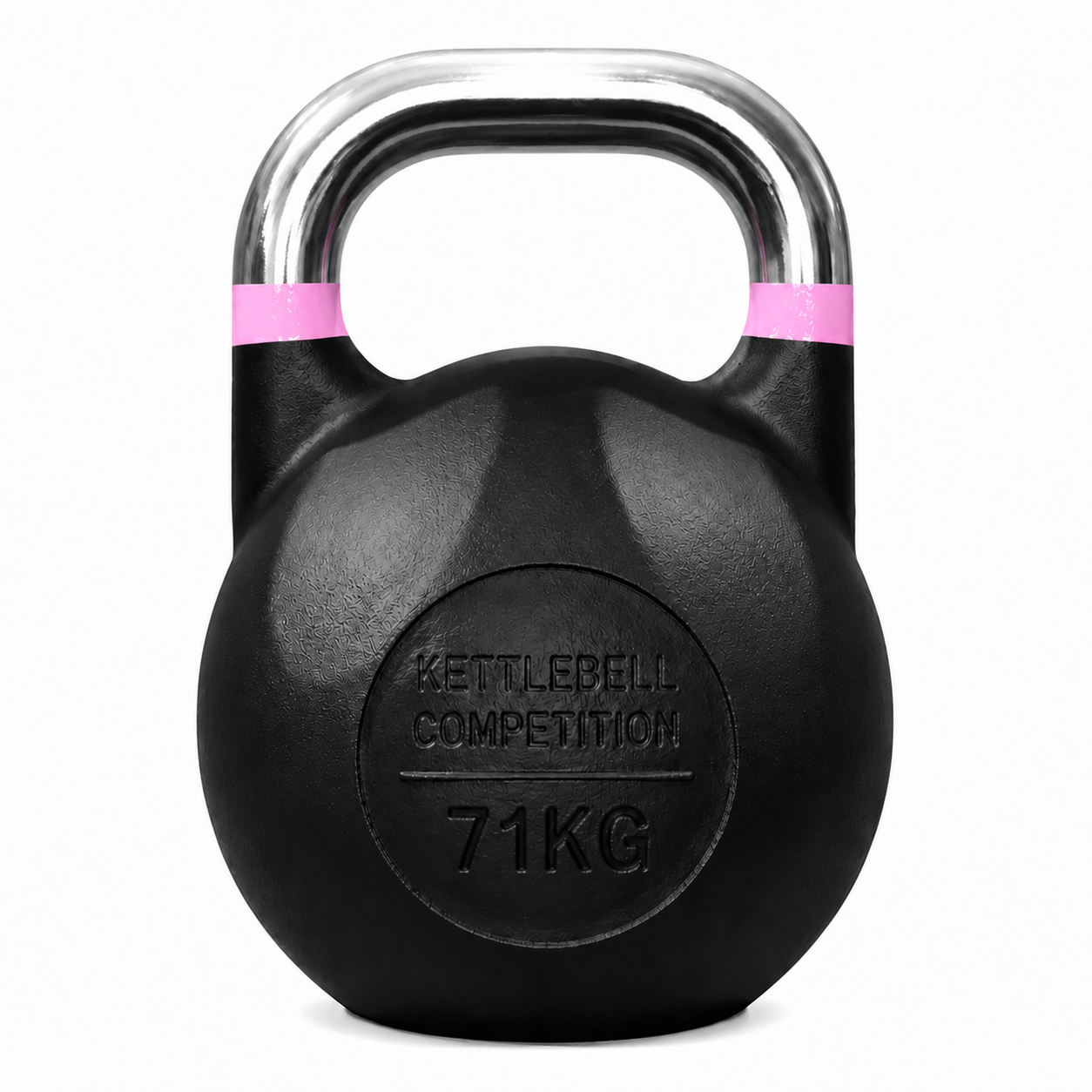
The 71 kg competition kettlebell is a specialized piece of strength equipment engineered specifically for the upper echelons of professional lifting and sanctioned strength sports. At this extreme weight class, the margin for error in both weight accuracy and structural balance is virtually non-existent. Our manufacturing process focuses on achieving a precise center of gravity, ensuring that the massive load remains predictable during complex movements like the snatch, clean and jerk, or heavy swings.
Unlike standard cast iron implements that may exhibit slight dimensional inconsistencies, this competition-grade model adheres to strict standardized sizing. This consistency is vital for athletes who rely on muscle memory and precise spatial awareness during high-stakes training or official events. The density of the high-grade steel used in construction allows for a compact body relative to its mass, which facilitates better movement mechanics compared to less refined alternatives.
Key performance characteristics include:
This implement serves as a cornerstone for athletes preparing for heavy-weight divisions. Whether utilized in a specialized strength facility or as part of a professional training regimen, the reliability of the equipment is paramount. For those looking to build a comprehensive training arsenal, our Competition Kettlebell Collection offers a range of calibrated weights to support progression from foundational strength to elite-level performance.
Precision in weight distribution is the defining characteristic of the 71 kg competition kettlebell. At this extreme mass, even a minor deviation in the center of gravity can significantly alter the physics of a lift, impacting both performance and safety. Our production line utilizes high-density steel casting to ensure that the volume-to-mass ratio remains optimized, providing a compact profile that is essential for high-velocity movements.
The following table outlines the core physical attributes and technical parameters of this specific model. These specifications are designed to meet the rigorous demands of professional strength training environments and sanctioned lifting events.
| Parameter Category | Detailed Specification | Technical Standard/Value |
|---|---|---|
| Nominal Weight | Mass per Unit | 71 kg |
| Primary Material | Core Composition | High-Grade Industrial Steel |
| Weight Tolerance | Calibration Accuracy | Strict Professional Grade |
| Body Geometry | Shape Profile | Standardized Competition Sphere |
| Handle Type | Grip Structure | Reinforced Steel Ring |
| Surface Finish | Texture/Coating | Smooth, Precision-Machined |
| Application Class | Usage Level | Elite / Professional Competition |
The standardized diameter of the handle is engineered to accommodate various grip thicknesses, ensuring that the athlete can maintain a secure hold during the most demanding phases of a lift. This dimensional consistency is a hallmark of professional-grade equipment, distinguishing it from recreational-grade alternatives that may lack the necessary structural density. Each unit is scrutinized to ensure that the physical dimensions align with the expectations of high-level strength athletes who require absolute predictability from their training tools.
Producing a 71 kg implement requires far more than basic casting; it demands a sophisticated integration of metallurgical expertise and precision engineering. The manufacturing of this competition kettlebell begins with the selection of high-density industrial steel, chosen for its ability to maintain structural integrity under the immense gravitational and centrifugal forces encountered during high-velocity lifts. This material selection is the first step in ensuring that the product can withstand the rigors of professional strength training without the risk of structural fatigue or weight shifts.
The core of our process involves advanced casting techniques designed to eliminate internal air pockets and material inconsistencies. By utilizing high-precision molds, we ensure that the 71 kg mass is distributed with mathematical exactness throughout the sphere. This stage is critical for achieving a balanced center of gravity, which prevents the "wobble" or unpredictable movement often found in lower-grade equipment. Once the initial form is cast, the unit undergoes a secondary machining process to refine the handle and the body surface, ensuring the dimensions remain within the strict tolerance thresholds required for sanctioned competition.
Quality assurance for an implement of this magnitude is an iterative and exhaustive process. Every single 71 kg unit is subjected to a multi-stage calibration protocol. This is not a mere estimation; we utilize high-precision electronic scales and calibration tools to verify the mass before the product leaves our facility. This rigorous verification ensures that the weight is not only accurate but also consistent across the entire production run.
Furthermore, the handle assembly is inspected for uniformity. The thickness and surface texture of the grip ring are measured to ensure they provide a predictable tactile experience for the athlete. This level of scrutiny extends to the surface finish, where any microscopic irregularities that could compromise a secure grip are identified and corrected. By maintaining these exacting standards, we provide professional strength facilities with equipment that is both reliable and compliant with the highest industry expectations.
The 71 kg competition kettlebell is not a general-purpose training tool; it is a specialized instrument intended for advanced strength athletes, professional lifters, and high-performance training facilities. Due to its extreme mass, this implement is primarily utilized in the final stages of strength peaking, heavy-load conditioning, and official sanctioned lifting events. It is specifically designed for movements that require absolute structural stability and predictable weight distribution under extreme tension.
This equipment is engineered for a specific tier of users, including:
While the 71 kg mass is unsuitable for foundational skill development, it serves as a critical component in advanced training protocols. Common applications include:
Handling an implement of this magnitude requires strict adherence to safety protocols to prevent injury and equipment damage. Because of the significant kinetic energy generated by a 71 kg mass, the following precautions are essential:
A stable, high-impact flooring system must be utilized to absorb the force of the kettlebell during drops or failed lifts. Athletes must ensure they are operating in a clear, unobstructed space with adequate room for movement. Given the extreme weight, it is highly recommended that any training involving this implement be conducted under the supervision of a qualified professional or within a controlled, professional-grade strength environment. Always verify your grip stability and spatial awareness before initiating high-intensity movements.
Maintaining a high-mass implement like the 71 kg competition kettlebell is essential for preserving both its structural integrity and its precise weight calibration. Because this product is constructed from high-grade industrial steel, it is susceptible to environmental factors such as oxidation and surface degradation if not handled with professional care. Regular maintenance ensures that the surface texture remains consistent and that the weight distribution remains unaffected by material loss or corrosion.
Even in professional strength facilities, humidity and perspiration can introduce moisture to the steel surface. To prevent the onset of oxidation or rust, it is imperative to wipe the kettlebell down with a clean, dry cloth after every training session. For implements used in high-intensity environments, a light application of a specialized metal protectant or a thin layer of machine oil can provide an additional barrier against moisture. This practice maintains the smooth, precision-machined finish of the handle and body, ensuring a predictable tactile experience for the athlete during future sessions.
The storage of such a significant weight requires more than just physical space; it requires a controlled environment. To ensure the longevity of the 71 kg steel construction, follow these storage standards:
By adhering to these professional maintenance and storage standards, facility managers and elite athletes can ensure that this 71 kg competition-grade tool remains a reliable asset for years of high-performance strength training. Consistent care directly correlates to the preservation of the tool's standardized dimensions and its overall operational safety.
Acquiring high-mass implements like the 71 kg competition kettlebell requires a strategic approach to procurement, particularly for professional strength facilities and elite training centers. Given the specialized nature of this equipment, sourcing should focus on suppliers capable of providing verified, competition-grade steel implements that meet strict dimensional and weight calibration standards. When planning a bulk acquisition or a single-unit purchase for an elite athlete, it is essential to prioritize manufacturers that emphasize metallurgical integrity and precision engineering.
When evaluating potential suppliers for extreme-weight equipment, procurement officers and facility managers should consider the following factors:
For organizations looking to develop a comprehensive training ecosystem, we offer various options to meet specific institutional needs. Whether you are looking to expand your current inventory or require specialized assistance with high-mass equipment, our team is available to provide detailed technical information. For specialized requirements or large-scale facility setups, please use the Contact Us page to initiate a consultation regarding your specific procurement timeline and technical specifications.
Investing in professional-grade equipment like this 71 kg kettlebell is a commitment to the long-term reliability of your strength training environment. By selecting implements that adhere to rigorous manufacturing and quality control standards, you ensure that your facility remains at the forefront of professional strength development and sanctioned competition readiness.
The 71 kg competition kettlebell represents the intersection of extreme mass and high-precision engineering. For athletes operating at the absolute limit of human strength, the reliability of their equipment is not merely a preference but a fundamental requirement for safe and successful performance. By prioritizing standardized dimensions and rigorous weight calibration, this implement ensures that every lift is conducted against a predictable and stable load.
Selecting this professional-grade tool provides several long-term advantages for high-performance environments:
Whether utilized for establishing new personal records or for maintaining peak strength in professional training facilities, the 71 kg competition kettlebell serves as a durable and precise asset. Maintaining the standards of care and storage outlined in our technical guidelines will ensure that this high-performance implement remains a cornerstone of your strength development for years to come.
| Attributes | Values |
|---|---|
| Weight | 71kg |
| Logo | Customizable |
| Specification | Customizable,MOQ |
| Color | Red, Orange, Yellow, Green, Cyan, Blue, Purple, Customizable |
Sarah Henry
Redefining Stability with Non-Traditional GeometryThe 22kg special shaped kettle...
Verified Buyer
PU Kettlebells, a product by Leadman Fitness, a prominent fitness equipment manu...
James R.
Redefining Resistance Through Geometric VariationThe 20kg special shaped kettleb...